As the fields of engineering, construction, architecture, and manufacture expand, one metal has proven itself on multiple projects and applications as the most reliable and accepted product in each of those industries – stainless steel. Not only do stainless steel sheets and stainless steel hex bars provide high strength, versatility, and the ability to resist corrosion, but they are also used extensively in many applications like pipe racks for large towers, all types of kitchen appliances (including sinks and ranges), automobiles, various precision machined components, etc.
Here is an overview of stainless steel’s production process as well as why it is one of the most important materials used by the entire global population.
What Exactly Is Stainless Steel?
An alloy of iron and various other materials, adding chromium to the iron, allows for the formation of a permanent layer around the metal called a passive film; therefore, a minimum of 10.5% chromium content characterises stainless steel. This layer provides protection from corrosion, rusting, and staining, thus making stainless steel appropriate for applications requiring long-term structural performance or exposure to chemicals and extreme climatic conditions.
Nickel improves ductility and toughness, while molybdenum gives added resistance to pitting corrosion for marine and chloride-rich conditions.
How Is Stainless Steel Manufactured?
Manufacturing stainless steel is an incredibly intricate, controlled procedure. Each step of the procedure guarantees that the end item will adhere to the internationally accepted quality and performance benchmarks for that particular product.
Raw Material Selection and Melting
All of the initial requirements are met through this stage of gathering iron ore, chromium, nickel, and recycled stainless steel scrap. All these items are melted in an electric arc furnace with temperatures of more than 1,600°C, where an extremely large amount of scrap is consumed. Therefore, the manufacture of stainless steel is generally more sustainable because less energy is required to manufacture it.
Removal of Impurities
The removal of sulphur, excessive carbon, and other impurities occurs after melting during the AOD (argon oxygen decarburisation) or VOD (vacuum oxygen decarburisation) processes. These processes are vital for producing the correct chemical composition of each grade of stainless steel.
Casting of Semi-Finished Forms
The molten metal is formed into semi-finished shapes like slabs, blooms or billets, which will later be utilized to make different types of stainless steels such as sheets, coils, rods and bars.
Hot Rolling
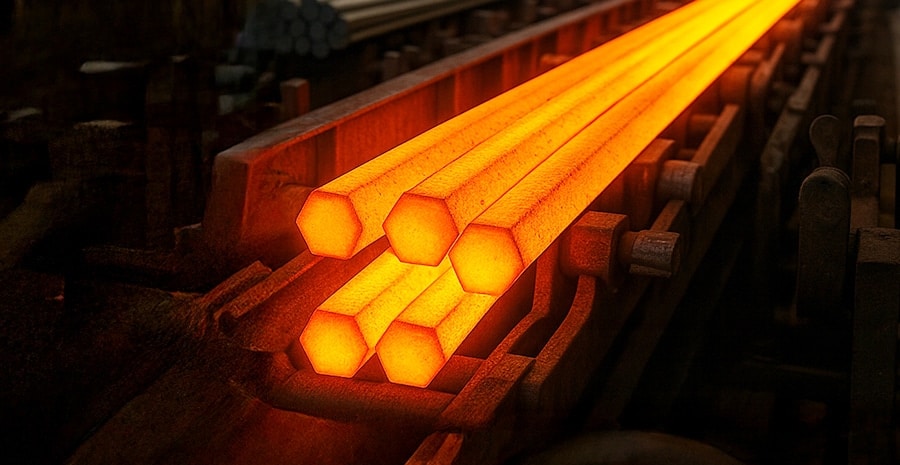
After having been cast into shape, the cast steels are next heated through the process of hot rolling to lower their thickness and to create uniformity among all pieces. The hot rolled cast billets are used to manufacture stainless steel hex bars, round bars and flat bars. Due to their high strength, good machinability and precision in dimensions, hex bars are specifically used in engineering applications.
Cold Working (optional)
Some stainless steel products are subjected to cold rolling or cold drawing to improve surface finish, hardness and dimensional accuracy. This is required for such parts that require tight tolerances and greater strength.
Heat Treating
In order to regain ductility that was lost due to forming, the stainless steel is heat-treated under controlled conditions. The process of annealing will relieve some of the internal stresses created during manufacturing and improve the corrosion resistance of the material.
Removal of Scale and Final Surface Finish
Heat treatment generates scale on surfaces that is removed via mechanical removal or through acid pickling. Various final finishing processes such as polishing, brushing, and bright annealing provide the unique appearance and smooth texture to the final product.
Inspection and Testing for Quality
Finally, before shipping to the company’s customers all over the world, the material is subjected to extensive mechanical testing, testing of its composition, and measurement of its dimensions.
Final Thoughts
There is more to stainless steel than just being a metal. It has become a backbone material for a multitude of industries and innovations. Stainless Steel’s strength, versatility and lifetime performance makes it an ideal choice for building modern infrastructure and precision engineering. The best stainless steel products manufacturers in India, like Viraj Properties, are among the most reputable manufacturers of stainless steel. They are committed to ensuring that all their products, whether they are stainless steel sheets or stainless steel hex bars, are manufactured to provide maximum durability and reliability.

Post A Comment