Precision manufacturing leaves very little room for material variability. Whether it is an automotive component being turned on a CNC machine, a pharmaceutical fitting being fabricated to hygiene standards, or an engineering assembly where every dimension has to be exact, the material going into these applications has to perform consistently, not just adequately.
Stainless steel round bars are one of the most widely used inputs across these industries. And yet the gap between a round bar that works well in precision applications and one that creates problems on the shop floor is wider than most buyers expect when placing an order.
Understanding what precision manufacturing actually demands from a round bar helps avoid those problems before they appear.
The Grade Has to Match the Environment
Precision industries are not uniform in what they need from a stainless steel grade. Pharmaceutical manufacturing typically specifies Grade 316L because of its low carbon content and superior resistance to the cleaning agents used in sterile environments. Automotive applications often call for Grade 303 because it machines cleanly and reduces tool wear during high volume production runs. Chemical processing equipment may require duplex grades where both strength and corrosion resistance need to be higher than standard austenitic grades can deliver.
Getting the grade right is the first decision and one of the most important. A bar made from the wrong grade may pass a visual inspection and still underperform in the actual application environment.
Dimensional Consistency Is Non Negotiable
In precision machining, the bar enters the process already close to its final dimension. Even small deviations in diameter, straightness, or ovality affect the finished component. A bar that varies across its length introduces inconsistency into every part machined from it, and tracing that back to the material takes time that production schedules rarely have.
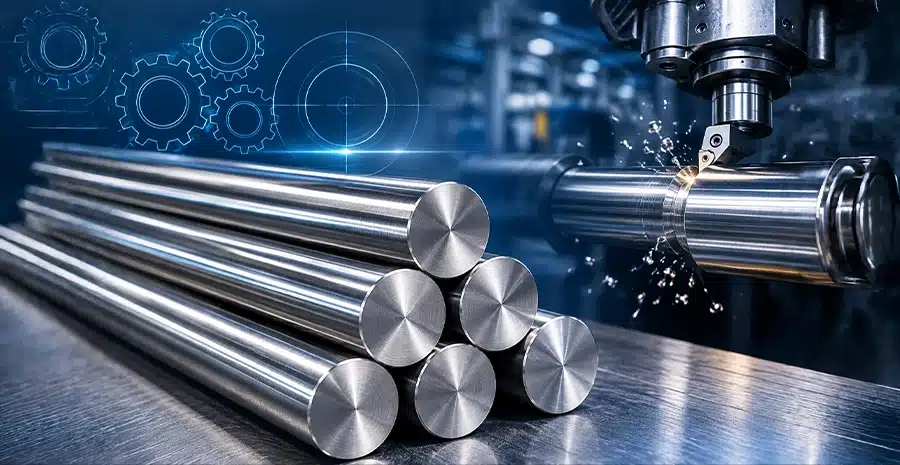
This is why bright finished round bars, produced through cold drawing, centreless grinding, or peeling, are specified for precision work rather than hot rolled alternatives. The finishing process brings the bar to tighter tolerances and a more predictable surface condition. What goes into the machine is consistent, so what comes out is consistent too.
Surface Condition Affects the Outcome
Surface finish on a round bar is a functional requirement in precision applications, not an aesthetic consideration. In food processing and pharmaceutical environments, a rough or inconsistent surface creates areas where bacteria can accumulate and cleaning becomes difficult. In precision machining, poor surface condition affects tool life and introduces variability into the finished component quality.
The finish standard has to be specified alongside the grade, and it has to be maintained consistently across the full batch.
Traceability Matters in Regulated Industries
Pharmaceutical, food processing, and aerospace applications all operate under regulatory frameworks that require material traceability. Knowing the grade, batch, chemical composition, and mechanical properties of every bar used in a critical assembly is not optional in these sectors.
A stainless steel manufacturer in India who controls the production process from melting through to finishing can provide that traceability clearly and completely. At Viraj Profiles, every batch of round bars is accompanied by material test certificates covering chemical and mechanical properties, giving buyers in regulated industries the documentation they need without having to chase it.
What We Bring to Precision Applications
At Viraj Profiles, we produce stainless steel round bars across grades including 303, 304, 304L, 316, 316L, duplex and others, with cold drawing, centreless grinding, heat treatment and finishing handled in house. The process is controlled from the melt stage, which means composition consistency and dimensional accuracy are built in from the beginning rather than corrected at the end.
For precision manufacturing buyers, that level of process control and documentation is what separates a supplier they can rely on from one they are constantly monitoring.
Final Thought
Precision manufacturing demands a great deal from the materials it uses. The right grade, consistent dimensions, appropriate surface finish, and clear traceability, all of it has to come together reliably, across every order. That is what we focus on at Viraj Profiles, and it is what our customers in precision industries across 96 countries have come to expect from us.
FAQs
Which grade of round bar is best for pharmaceutical applications?
Grade 316L is the most commonly specified for pharmaceutical use. The low carbon content reduces the risk of carbide precipitation during welding, and the grade handles the cleaning agents used in sterile environments reliably. Surface finish is equally important and should be specified alongside the grade.
We do a lot of CNC turning. Which grade machines are the best?
Grade 303 is specifically designed for improved machinability. The sulphur addition in its composition helps the bar cut cleanly, reduces tool wear, and produces a better surface finish on machined components. For high volume turning work it makes a noticeable difference compared to standard 304.
How do you maintain dimensional consistency across a large order?
We control the process from melting through to finishing in house, dimensional checks run through every stage of production. Every batch is inspected before despatch. There are no outside parties handling different stages, which means fewer variables and more predictable output across large volumes.
Can you supply round bars with a polished finish for food grade use?
Yes. We produce round bars in finishes suited to food processing environments including bright annealed and polished options. Grade 316 or 316L with appropriate finish is standard for most food grade applications and is part of our regular production range.

Post A Comment