Stainless steel round bars go into some of the most demanding applications in modern industry. Pharmaceutical equipment, automotive components, precision engineering assemblies, food processing machinery — these are not environments where average material performance is acceptable. The bar has to machine predictably, hold its dimensions consistently, and behave the same way whether it comes from the first order or the fifteenth.
At Viraj Profiles, we have been manufacturing stainless steel round bars for over three decades. The way we approach production has been shaped by what demanding industries actually need. Not just in terms of grade and size, but in terms of the process discipline that determines whether the bar performs as specified once it reaches the customer.
It Starts at the Melt
Most people think of a round bar as a finished product. For us, it starts much earlier — at the melting stage. We control raw material composition from the very beginning, which means the chromium, nickel, and alloying element balance is set before any rolling or drawing takes place.
This matters because inconsistencies in composition cannot be corrected downstream. A bar drawn to tight tolerances from poorly controlled melt chemistry will still carry those inconsistencies through to the finished product. Starting from the melt means we own the quality of the material before it becomes a bar.
Rolling and Drawing With Process Control
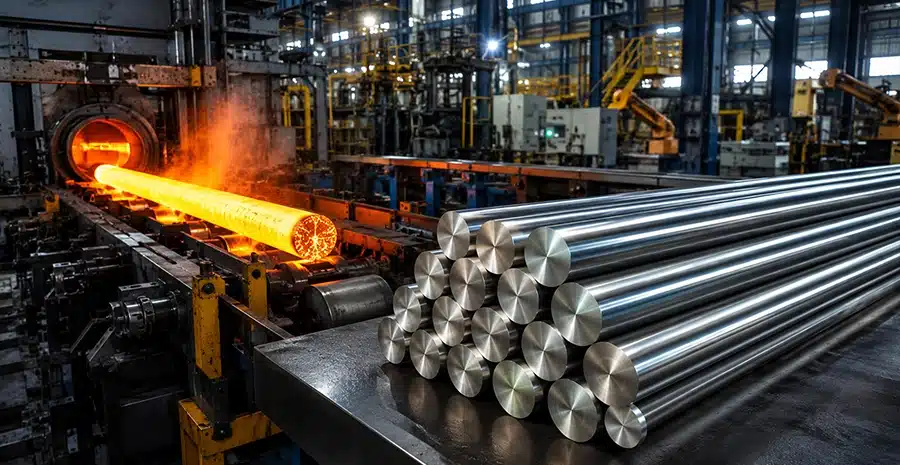
Once the material moves through casting and rolling, it enters the cold finishing stage. Cold drawing, centreless grinding, or peeling — the process used depends on the grade, the dimension, and the application the bar is going into.
Cold drawing improves surface finish and brings the bar closer to its final dimension while also refining the mechanical properties. Centreless grinding takes dimensional accuracy further, producing bars with tight tolerances across the full length. For precision applications, this stage is where the bar either meets the requirement or it does not. We treat it accordingly.
Heat Treatment as a Process Step
Heat treatment is not an afterthought in our process. Annealing, stress relieving, or solution treatment — whichever is appropriate for the grade is carried out in house before finishing. This ensures the material properties are correct before the bar goes through its final surface processing and inspection.
For grades like 316L used in pharmaceutical applications, or duplex grades used in chemical processing, heat treatment is critical to achieving the corrosion resistance and mechanical behaviour the application demands. Doing it in house means we control it, full stop.
Surface Finish for the Application
Different industries require different surface conditions. A bar going into a food processing facility has different surface finish requirements than one going into a structural engineering application. We produce round bars across multiple finish standards — bright annealed, ground, polished — depending on what the end use demands.
Surface finish is something we treat as a functional specification, not a cosmetic one. In hygiene critical industries, a consistent surface condition directly affects cleanability and corrosion performance. In precision machining, it affects tool life and the quality of the finished component.
Testing and Traceability Before Despatch
Every batch of round bars goes through dimensional inspection, surface condition checks, and material verification before it leaves our facility. Material test certificates accompany every order, giving buyers in regulated industries the traceability they need from melt to finished product.
As a stainless steel manufacturer in India supplying to buyers across 96 countries, we have built documentation practices that hold up to the scrutiny of international markets along with domestic requirements.
Final Thought
Manufacturing stainless steel round bars to demanding industry standards is not about having the right equipment. It is about controlling every stage of the process with the same level of attention, from the melt through to despatch. That is what we have been doing at Viraj Profiles for over thirty years, and it is what global industries have come to rely on from us.
FAQs
1. What grades of stainless steel round bars do you manufacture?
We produce round bars across a wide range of grades including 304, 304L, 316, 316L, 303, 410, 420, duplex, and several others. The grade depends on the application and the environment the bar will be used in. Our team can help identify the right grade for your specific requirement.
2. What surface finishes are available for round bars?
We offer round bars in bright annealed, centreless ground, peeled, and polished finishes depending on the application. Hygiene critical industries typically require smoother finishes, while structural applications may work with a standard ground finish. We can discuss what is right for your use.
3. How do you ensure dimensional consistency across large orders?
Dimensional control runs through our entire production process, from rolling through to final finishing. Every batch goes through inspection before despatch. Because we control the process from melt to finished product, we can maintain consistency across large volumes in a way that is difficult to achieve when production is split across multiple parties.
4. Do you provide material test certificates with every order?
Yes. Material test certificates covering chemical composition and mechanical properties accompany every order. For industries with specific traceability requirements, we can discuss additional documentation needs before the order is placed.
5. Can you supply round bars for pharmaceutical or food grade applications?
Yes. We manufacture round bars in grades and surface finishes suited to pharmaceutical and food processing applications. Grade 316L with appropriate surface finish is commonly specified for these environments and is part of our standard production range.

Post A Comment